
- Location
- Montreux, Suisse
- Floor area
- 350sqm
- Year
- 2026
- Role
- Design and project direction
- Escape room
- Bar
The starting point
In Montreux the clients had the concept before they had the venue: a genuine den drawn from fairy tales. When they found a building on two levels, the project took shape: a tavern at street level and, in the basement, two escape rooms.
The constraint of the building then became a strength. A basement is less naturally inviting to the public, but it offers exactly what an immersive escape room needs: darkness, isolation and a break with the outside world.
From the first meeting the brief given to Pix was clear: make La Plume des Contes, the first room of the project, an experience able to stand alongside the best rooms in the TERPECA ranking, above all on the quality of its sets, its mechanisms and its effects.
The design decision
The tavern becomes the shop window of the project. Visible from the street, it welcomes visitors and makes them want to find out what lies downstairs.
Pix worked on the bar layout and on the identity of the venue, built around a thatched-roof fairy-tale house. The same world follows the visitor across both levels, but its register shifts as they go: warm and welcoming in the tavern, then mysterious and finally spectacular in the game.
The project is also designed to grow. A second escape room is allowed for from the outset, so that it can be built later without calling the general organisation of the basement into question.
The design work
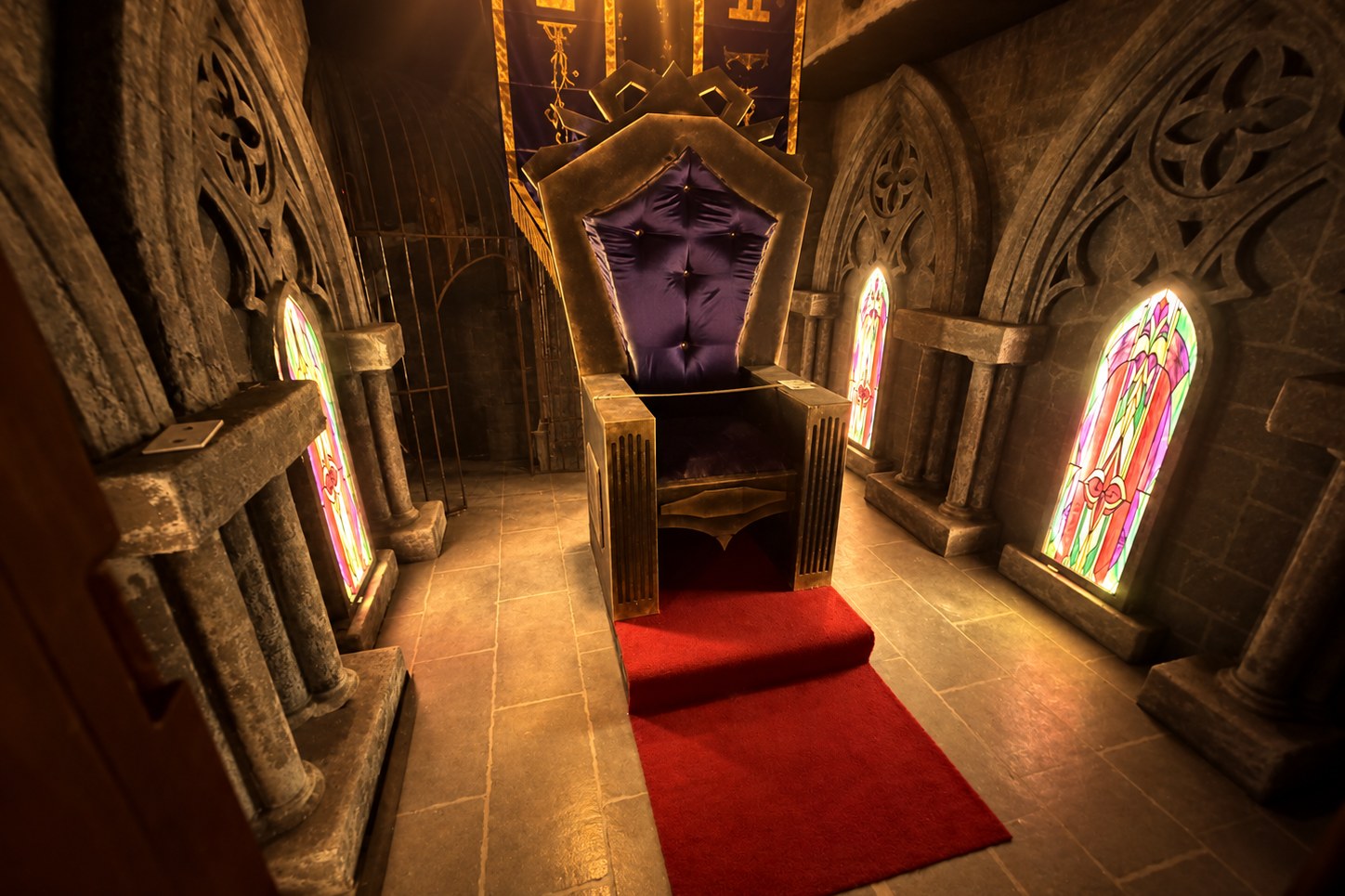
Pix designed the whole of La Plume des Contes: storyline, player journey, drawings, sets, mechanisms, flow charts and the technical dossier the various trades build from. The route runs through five successive play spaces, from queen Calista's castle to the treasure room.
The story rests on a simple mission: Calista has stolen the magic quill that gives fairy tales their happy endings. Players have to get into her castle, free Phénix, their guide, recover the quill and restore the stories to their original course.
All along the route players come across references to the great tales of childhood: Cinderella, Rapunzel, Snow White, Aladdin, and Andersen's Snow Queen. Those references are not decoration: they become the substance of the puzzles themselves.
Three principles shape the design:
- Universal. An intuitive experience, built to work beyond the players' language and culture.
- Self-resetting. The mechanisms and sequences are designed to keep resetting between sessions to a minimum.
- Controlled remotely. The game master can follow and drive the experience from a dedicated interface, so that day-to-day operation stays light.
That last point is essential: designing a good escape room is not only about creating a spectacular experience. It also means designing a model that can be run profitably, day after day.
The build
Pix does not stop at the design. The team sources the trades, turns the concept into buildable solutions and follows the works through.
The room combines physical mechanisms, sensors, light, sound and special effects. Some moments are staged as genuine show sequences: light beams, vapour to simulate melting ice, effects around Phénix, bubbles and a light show, through to the finale where the black quill turns white before the players' eyes.
Every effect is designed against a double requirement: to produce a memorable moment for the player, and to stay reliable, maintainable and operable for the venue.
That is the whole of Pix Entertainment's approach on this project: not simply to draw an escape room, but to design the experience, the engineering and the running of it as one and the same product.
The sets under construction
The result
The venue as delivered
What Pix did, exactly
Feasibility study, bar layout, identity of the venue, writing of the world and the storyline, player journey, drawings, sets, mechanisms, flow charts, technical dossier, sourcing of the trades and support through construction.